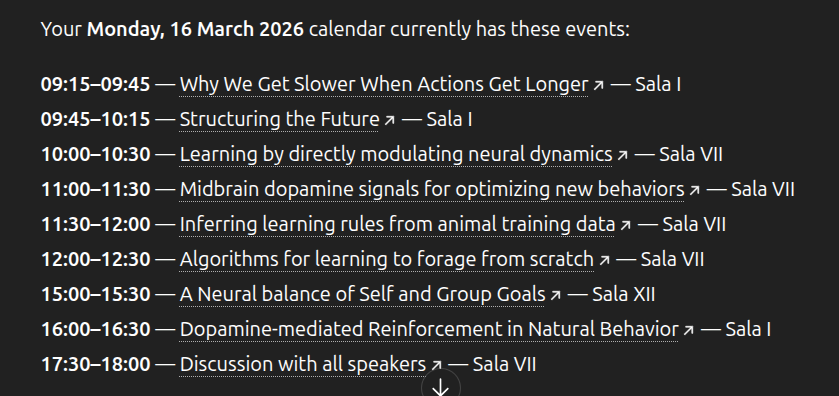
Cosyne 2026
Single consolidated note for the only Cosyne attended so far.
Conference leads and follow-ups
-
Joshua Dudman — dopamine learning signal
- Nature paper: https://www.nature.com/articles/s41586-022-05614-z
-
Francois Rivest (Canada) — timing using DDM
-
Exponential and accumulation are same?
- Look for relevant paper(s) by this author: https://scholar.google.com/citations?user=lMS8agIAAAAJ&hl=en
-
Uchida — TD value calculation circuit
- bioRxiv preprint: https://www.biorxiv.org/content/10.1101/2025.09.18.677203v1
-
Michael Leprori — Brown University
- Contravariance principle
- Harder tasks → more unique solution
-
Cell learning / single-cell “working memory”
- Aneta Koseska
- eLife paper: https://elifesciences.org/articles/76825
- Note: working memory in cells
- ChatGPT explanation / summary link: https://chatgpt.com/s/t_69bad2ddfad081919e040b58a40c292e
- Skeptical note: another example of overclaiming single-cell behaviour. They frame it as working memory, but it may just be slow decay of the signal caused by underlying biochemistry — basically the same flavor as habituation, i.e. decay of a remanent signal.
-
Iain M. Banks
- Culture series
- Note: often referred to informally here as “Ian Banks”
-
Halstead complexity
- Constraint on AlphaEvolve’s solutions
- https://en.wikipedia.org/wiki/Halstead_complexity_measures
-
Barlow vs Hebb
- Find/reference the relevant paper
Related talks and references
COSYNE 2024 talks
- Playlist: https://www.youtube.com/playlist?list=PL9YzmV9joj3EjkmmUEodJNDq9ekI7iFjq
- Session 3
- What is intelligence — life and prediction are safe. How order emerges out of chaos.
- Estrogen regulates dopamine and enhances learning by suppressing re-uptake of dopamine.
- Ching Fang, Abbott’s lab — adding auxiliary loss helps better learning; multi-region modelling using Deep RL.
- Christopher Zimmerman — learning from events that happened well in the past (hours before); shows how a brain region is identified.
- Neural coding.
- Srjan Osdac — geometry of responses in IC, A1; how manifolds (PC-1,2,3) change with time (100 ms blocks).
Interpretability
- Belief dynamics
- Rabbit hull paper
- Task geometry paper
- Marginal value theorem
- For foraging; visiting time is proportional to reward rate
- Mechanical problem solving in mice
- Task where mice have to do lever presses / slide things to get reward
- Potentially a good paper for compositionality
- Dragon king theory
- BBP phase transition
- The BBP phase transition (named after Jinho Baik, Gérard Ben Arous, and Sandrine Péché) describes a phenomenon in Random Matrix Theory where the largest eigenvalue of a “spiked” random matrix suddenly detaches from the main bulk of eigenvalues once the strength of a signal exceeds a critical threshold.
- Usage note: neural network training — analyze the Hessian (curvature) of the loss landscape at initialization to see whether a gradient-based method can “find” the signal.
Imported from Google Keep (2026-03-23)
Workshop fragment
- BBP phase transition
- Representation for motor output, not decoding
Workshop image