Mathematical Framework of Transformers;
Notes: No MLP layers No bias No layer norm
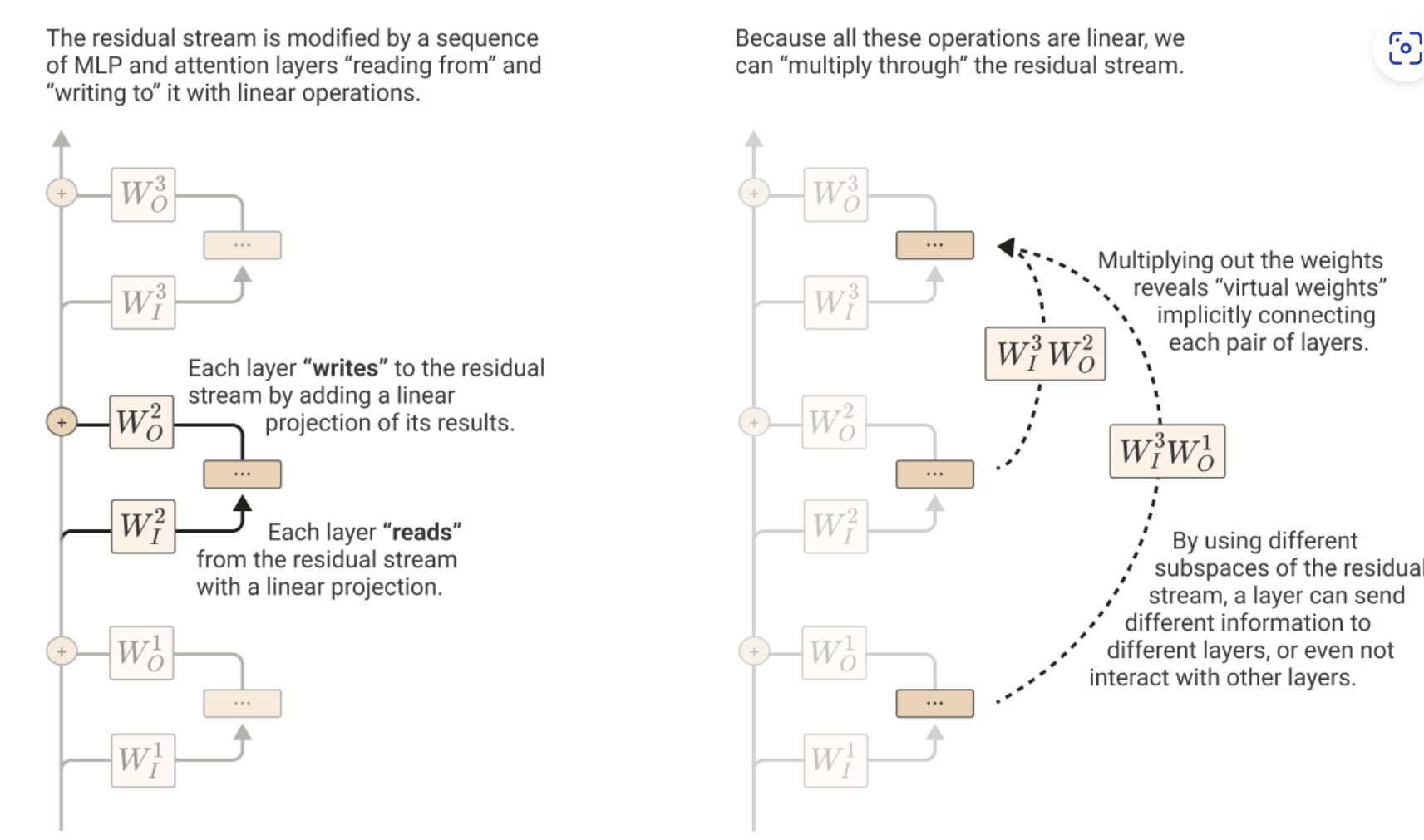
”attention and MLP layers each “read” their input from the residual stream (by performing a linear projection), and then “write” their result to the residual stream by adding a linear projection back in”
Residual stream: The residual stream is simply the sum of the output of all the previous layers and the original embedding.
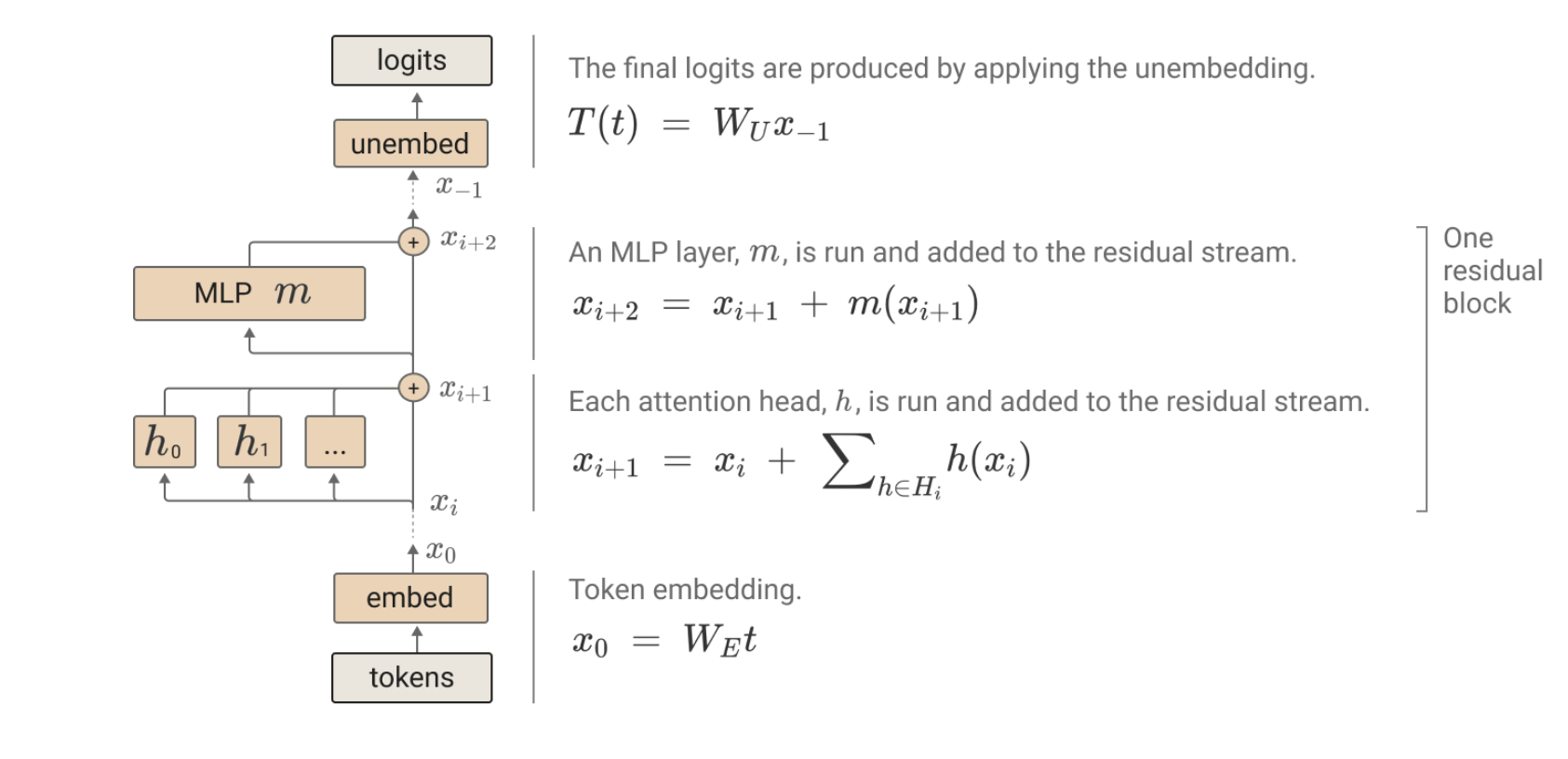
Only linear operations are done to the Residual stream
Induction heads, superposition, SAEs, papers
Source PDF:
Imported content from PDF
Links / references
- Continual learning: https://jessylin.com/2025/10/20/continual-learning/
- Augmentation disambiguates what hypothesis we want to learn
- 2afc task in haiku: https://transformer-circuits.pub/2025/linebreaks/index.html
- Data Distributional Properties Drive Emergent In-Context Learning in Transformers
- Infant statistical learning: https://www.annualreviews.org/content/journals/10.1146/annurev-psych-122216-011805
- NeurIPS 2023 paper: https://proceedings.neurips.cc/paper_files/paper/2023/file/58692a1701314e09cbd7a5f5f3871cc-9-Paper-Conference.pdf
- In-context learning occurs as a competition between in-weights and in-context learning circuits throughout training
- Theoretical understanding of the above in-context learning: https://openreview.net/pdf?id=aKJr5NnN8U
- Memorization and weight decomposition: https://arxiv.org/pdf/2510.24256
- Related paper: https://pmc.ncbi.nlm.nih.gov/articles/PMC11661294/
Notes
- Augmentation disambiguates what hypothesis we want to learn.
- Data distribution helps in-context learning and in-weights learning.
- In-context learning occurs as a competition between in-weights and in-context learning circuits throughout training.
TODO
- See attention matrices in ICL examples and see where they attend.
- Check whether rare classes are actually necessary to prevent memorization, and hence for better ICL.
- Test whether a small number of classes + L2 regularization can still produce good ICL.
Experiment idea
Hypothesis: with a small number of classes, adding L2 regularization / AdamW weight decay may still suppress in-weights memorization enough to yield good ICL.
Quoted framing from the imported note, cleaned lightly:
Yes—totally testable. The hypothesis is: with few classes (so rare classes are not present), adding L2 / weight decay during bursty training might still suppress in-weights memorization enough to yield good ICL.
Experimental design
Core grid (2×2 + L2 sweep):
- Number of classes: few (for example 100) vs many (for example 1600)
- Burstiness: high for all runs, for example p(bursty) = 0.9
- L2 / AdamW weight decay: 0, 3e-4, 1e-3, 3e-3, 1e-2
- Model: same transformer as the paper (12L, d = 64)
- Optional model capacity check: small vs medium, for example d = 48 vs d = 96
Controls:
- Fix total tokens and per-class exposure budget across conditions so this is not confounded with seeing less data.
- Keep augmentations and label vocabulary identical across conditions.
- Maintain sequence format: 16 context tokens (8 image→label pairs) + 1 query image.
- In bursty sequences, the query class repeats 3 times, plus one distractor class repeated 3 times.
- Use AdamW with decoupled weight decay.
- Exclude decay on LayerNorm γ/β, all biases, and embedding tables.
- If the repo already uses Adam, switch to AdamW.
- If it uses raw L2 added to the loss, prefer AdamW to avoid interactions with adaptive moments.
Metrics to record per step:
- ICL accuracy on holdout classes (for example 2-way 4-shot with label remapping)
- In-weights accuracy on seen classes
- Transience curves: ICL and in-weights vs training steps
- Calibration / ECE on holdout episodes (optional)
- Attention diagnostics during ICL evaluation:
- query-token attention mass on the matching context image
- query-token attention mass on the label following that image
Success criterion:
- In the few-classes + moderate-L2 setting, ICL reaches about 90% of the many-classes + 0-L2 baseline peak, without catastrophic drop in overall accuracy or collapse of attention patterns.
Expected outcome / forecast:
- Few classes + no L2: the model quickly memorizes → low ICL, high in-weights
- Moderate L2 (around 1e-3): memorization becomes more expensive and ICL should improve
- Too much L2 (around 1e-2 or above): likely hurts both via underfitting / weaker multi-hop attention
- Many classes + bursty training likely remains the most reliable route to strong ICL
- Few classes + moderate L2 may still close much of the gap
Run plan:
- Pick seeds {0, 1, 2}.
- Train each configuration to a fixed step budget, for example the step where the paper’s ICL peaks plus margin.
- Every N steps (for example every 1k), log:
- ICL holdout accuracy
- in-weights seen-class accuracy
- attention heatmaps for fixed example episodes
- Plot:
- ICL vs steps
- in-weights vs steps
- peak ICL across L2 values
Interpretation:
- Hypothesis supported: a sweet-spot L2 value, likely around 1e-3, lets the few-classes setting recover strong ICL and preserve the expected query → matching image → label attention path.
- Hypothesis not supported: ICL remains low in the few-classes setting regardless of L2, or both ICL and in-weights drop together as L2 rises, suggesting many rare classes contribute something L2 cannot replace.
Raw imported text
Below is the raw imported content, lightly normalized into Markdown so the note preserves the PDF dump rather than only a summary.
Continual learning: https://jessylin.com/2025/10/20/continual-learning/
Augmentation disambiguates what hypothesis we want to learn.
2afc task in haiku: https://transformer-circuits.pub/2025/linebreaks/index.html
Data distribution helps in-context learning and in-weights learning.
Data Distributional Properties Drive Emergent In-Context Learning in Transformers.
TODO:
- See attention matrices in ICL examples, see where they attend.
- Rare classes may not be necessary to prevent memorization (and hence better ICL). Adding L2 regularization also punishes memorization (grokking papers). So the guess is maybe with a small number of classes + L2 regularization, good ICL can be achieved.
Suggested by ChatGPT: Yes—totally testable.
Hypothesis: with few classes (so “rare classes” are not present), adding L2 / weight decay during bursty training might still suppress in-weights memorization enough to yield good ICL.
Experimental design grid (core 2×2 + L2 sweep):
- Number of classes: Few (e.g. 100) vs Many (e.g. 1600)
- Burstiness: High (e.g. p(bursty) = 0.9) for all runs
- L2 (AdamW weight decay): {0, 3e-4, 1e-3, 3e-3, 1e-2}
- Model: same transformer as paper (12L, d = 64)
- Optional: add Small vs Medium capacity check (e.g. d = 48 vs d = 96)
Controls:
- Fix total tokens and per-class exposure budget across conditions.
- Keep augmentations and label vocab identical across cells.
- Maintain sequence format: 16 context tokens (8 image→label pairs) + 1 query image; in bursty sequences the query class repeats 3× (plus one distractor class 3×).
- Use AdamW with decoupled weight decay.
- Exclude decay on LayerNorm γ/β, all biases, and embedding tables.
Metrics to record (per step):
- ICL accuracy on holdout classes (2-way 4-shot with label remapping)
- In-weights accuracy on seen classes (standard eval)
- Transience curves: ICL and in-weights vs training steps
- Calibration (ECE) on holdout episodes (optional)
- Attention diagnostics during ICL eval: query token attention mass on (i) matching context image, (ii) its following label
Success criterion:
- In the Few-classes + some-L2 cell, ICL reaches ≥90% of the Many-classes + 0-L2 baseline peak, without catastrophic drop in overall accuracy or collapse of attention patterns.
Honest forecast:
- With few classes + no L2, the model quickly memorizes → low ICL, high in-weights.
- Adding moderate L2 (≈1e-3) should lower in-weights and lift ICL somewhat.
- Too-high L2 (≥1e-2) likely hurts both.
- Many-classes + bursty + little/no L2 will probably remain the most reliable path to strong ICL.
Run plan:
- Pick seeds {0, 1, 2}.
- Train each config to a fixed step budget.
- Every N steps (e.g. 1k), log ICL_holdout_acc, InWeights_seen_acc, and attention heatmaps.
- Plot ICL vs steps, In-weights vs steps, and a bar chart of peak ICL across L2 values.
Infant statistical learning: https://www.annualreviews.org/content/journals/10.1146/annurev-psych-122216-011805
NeurIPS 2023 paper: https://proceedings.neurips.cc/paper_files/paper/2023/file/58692a1701314e09cbd7a5f5f3871cc-9-Paper-Conference.pdf
In-context learning occurs as a competition between in-weights and in-context learning circuits throughout training.
Theoretical understanding of the above in-context learning: https://openreview.net/pdf?id=aKJr5NnN8U
Memorization and weight decomposition: https://arxiv.org/pdf/2510.24256
Related paper: https://pmc.ncbi.nlm.nih.gov/articles/PMC11661294/
Induction Heads
Source PDF:
Note: the markdown below is an incomplete text conversion of the PDF. Treat the PDF as the source of truth for the full content.
Imported content from PDF
- Transformers do not need to process tokens sequentially the way hidden-state RNNs do.
- The residual stream can be pushed to drive model behaviour.
- Different blocks read from and write to the residual stream.
- You can read from the residual stream in advance and try to decode what the final outcome is going to be.
- The engineering trick of adding, rather than fully transforming, helps prevent vanishing gradients.
- If (F(\cdot) = 0), then with a residual connection the gradient can still be 1; without that addition, the gradient would be zero.
Raw imported text
Induction Heads
Transformers no need to process tokens sequentially like hidden state RNNs.
Pushing residual stream can be pushed to drive model behaviour. Different blocks read and write from it.
U can read from the residual stream in advance and try to decode what is going to be the final outcome.
Engineering trick to add not transform is due to prevent vanishing gradients.
If F(.) = 0 then gradient can be 1; if there is no residual addition and F(.) = 0, then gradient will be zero.
Additional Google Keep imports (2026-03-23)
RL, memory, and probing ideas
LLM + RL by self play ? to see
take smaller model and RL have itself as baseline also plain model + big models before and after RL: if RL is really powerful, trained correctly, impact of memory:
- impact of forgetting last 1 to N_memory traces: see if old trials are removed
- impact of mis-remember few of last N traces: see if old trials is corrupted
see stratergies - give same came to RLed model and non-RLed model
can u see invoking of relevent memory if u probe concepts
Memory editing / memory in LLMs
- ROME vs. MEMIT: https://levelup.gitconnected.com/rome-vs-memit-the-evolution-of-mass-editing-transformer-memory-e3e4af2ca206
- https://arxiv.org/pdf/2012.14913
- https://arxiv.org/pdf/2210.07229
Model geometry / manifolds
- Chasing the Counting Manifold in Open LLMs — https://huggingface.co/spaces/t-tech/manifolds#what-is-new-in-this-reproduction
Sampling / feature-space note
generation is sampling from interpretable features?
auto encoder , linearity impose, PCA Wd We x L (y - WdWe x)^2 N x d
latent are gaussian means weights are gaussian? it should depend on input distribution?
theorem? - feature space is sparse, u can invert ?
Salvaged non-personal idea fragments from Keep Todo
- Replicate the haiku counting task in Llama.
- Test whether AdamW + L1 / weight decay is enough to punish memorization, without needing rare classes.
- Look at attention matrices in ICL.
- RL on a card game: compare luck, strategy, and model differences on the same hands.
- Weber law in LLM word counting.
- Memex / ebook-reader / Codex style tooling ideas.
- Generalize the idea of why the OV circuit has to be diagonal.
- Understandability examples with simple systems (for example, a coffee machine).
- CDF as optimal rank encoding for arbitrary magnitude distributions?
- Drift-diffusion over-parameterization?
Emotions / probes note
- https://transformer-circuits.pub/2026/emotions/index.html
- Interesting that they seem to have stopped using SAEs and started using probes.
- Need to check it out.