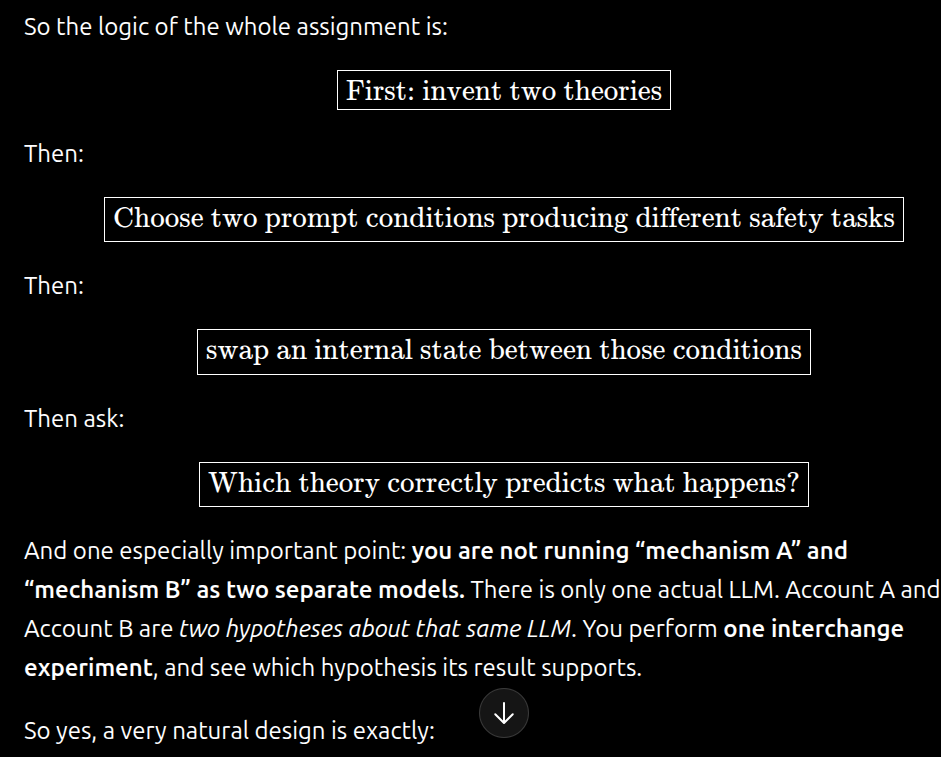
this is about direction in safety , refusal and compliance??
Appln ques
1. prior work
**As an independent side project, I recently worked on Bau lab’s April challenge[1] which asks you to reverse engineer a toy transformer that can find a maximum of 5 numbers. I found that more attention matrices are recruited to tweak the maximum response, and that the model’s operations can be interpreted as a low dimensional computation. This project helped me exercise thinking about internal matrix operations in a transformer block.
My approach and how I conduct research:
These are the research skills that I learnt over my ~4 years of working in neuroscience
-
Before I write code, I try to make things clear first on paper to get an intuition of how my outputs should be. For example, in this project, writing out each of the weight matrices, made it clear that it is enough to look only at the last row of attention matrices.
-
Before testing out any immediate hypothesis, I try to look at raw data to get a sense of what is in the raw data. Like here, embedding and unembedding norms, individual weight matrices, seeing attention patterns for different groups of examples.
-
The most valuable skill I learned in my lab is the process of hypothesis testing. Once I look at raw data, I start with the simplest hypothesis that I wish would be true. Check for correlative evidence first. If it exists, then test for causal manipulation. If it works, then test for as many alternate hypothesis as you can.(2,3)
How I can contribute:
Alongside the scientific methodology, I have done a good amount of programming and maths in my past projects. From neuroscience, I have been habituated to think about computation in low dimensional spaces, which is closely related to the representations related to refusal or compliance in the model’s activity for this project.**
references:
- bau lab challenge
- result sumary
- research log
- how to never be wrong
2. eng and empirical diagnosis
The key problem is that the behavior underlying six behavioral taxonomies is not mutually exclusive. While compliance and refusal are clear opposites of each other, there can be confusion when you consider other labels. For example, if the model refuses to a question, is it because it thought it is unsafe or did the system prompt contained a explicit instruction to not answer such queries. If we want to look at representations inside the model, and we find a direction, is it for refusal or hierarchy preservation.
To test such cases, one would have to design prompts which can disambiguate. For example
-
Prompt saying answer in french. The model would happily respond(compliance)
-
Prompt with system instruction saying always respond in english even if asked to do in other languages. And user instructions says “answer in french”
In case of (b), if the model doesn’t answer in french, then we can find a direction that differentiates compliance and hierarchy preservation. Of course, there is a confounding factor that the direction could be French. But such problems can be dealt with by having counter balancing examples, where French and English can be interchanged. Also, averaging across many prompts should cancel out such detailed prompt related directions.
But the challenge is, one can come up with multiple such pairs. Another possibility could be to collect activations related to all behavioral taxonomies, and find a low dimensional subspace where the the activations can be separated maximally using multiclass-LDA. And then the obtained directions could be tested in the same way as [1]. - check activation correlation with prompt(figure 5) and use causal manipulative methods like direction ablation to see if the behavior separates the effects(figure 1)
Now, there could be a possibility that we may not be able to find a subspace that maximally can differentiate six taxonomies. But before concluding the representations for different behavioral taxonomies overlap, we also have to test with non-linear methods. Recent methods like J-space also give a chance to look at model internals for individual examples, and give an insight at what intermediate computations led to the model’s response.**
causal abs