- larger models learn rare and less complex tasks bcoz of low gradient interference
https://arxiv.org/abs/2605.29548
- memorization may be necessary in long tail distributions bcoz there might not be a rule for raere examples that u see-
https://shiweiliuiiiiiii.github.io/
- https://arxiv.org/pdf/2506.00772
- https://arxiv.org/pdf/2603.15389 - sparsing curse of depth
LIFT the Veil for the Truth: Principal Weights Emerge after Rank Reduction for Reasoning-Focused Supervised Fine-Tuning
- fintuning only large magnitude weights s1: Simple test-time scaling
fine tuning weights related to attrn graphs?*
- Compute attribution graph for a training example.
- Union graphs across the dataset.
- Mark parameters participating in those graphs.
- Freeze everything else.
- Fine-tune only the discovered circuit.
todo
- read fine tuning LoRA,
- Sparse fine tuning
- then LIFT
- write fine tuning by hand
- try the fine tuning experiment by GPT, vast. ai
- think of plan that can be written.
LorA
-
Intrinsic Dimensionality Explains the Effectiveness of Language Model Fine-Tuning
- model
many NLP tasks have low intrinsic dimensionality, once u have a good pre-trained model
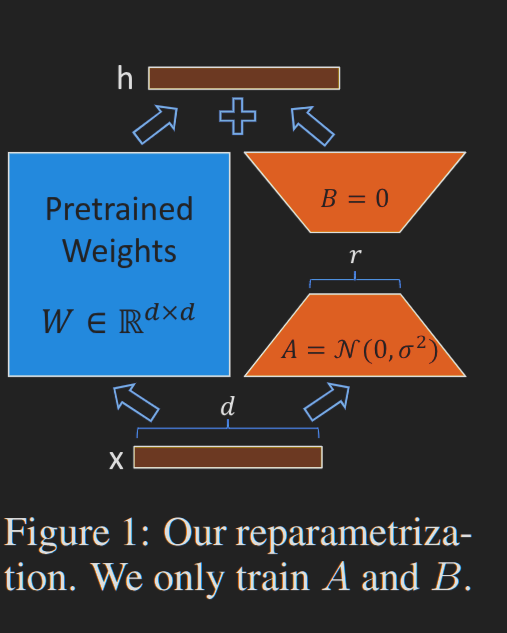
- model
many NLP tasks have low intrinsic dimensionality, once u have a good pre-trained model
-
they don’t do on MLP layers,
-
they don attn matrics - q and v. they tried all, but q and v, best for efficiency and performance
https://arxiv.org/pdf/1804.08838 MEASURING THE INTRINSIC DIMENSION OF OBJECTIVE LANDSCAPES W is the weight matrix. instead of training W. add W_flat + random project x w_low dim W is 100 x 100 = 10K w_flat will be 10K w_low dim can be 100 random proj will be 10K x 100 we train only w_low dim if u do that u find that u require far less params to change than MNIST
for llms, https://arxiv.org/abs/2012.13255 Intrinsic Dimensionality Explains the Effectiveness of Language Model Fine-Tuning
sparse fine tuning
https://arxiv.org/pdf/2406.03068 DISTRIBUTIONAL ASSOCIATIONS VS IN-CONTEXTREASONING: A STUDY OF FEED-FORWARD ANDATTENTION LAYERS
attention doing in context reasoning and MLPs doing association
https://proceedings.iclr.cc/paper_files/paper/2024/file/4c2092ec0b1370cce3fb5965ab255fae-Paper-Conference.pdf THE TRUTH IS IN THERE: IMPROVING REASONING IN LANGUAGE MODELS WITH LAYER-SELECTIVE RANK REDUCTION